B2B Lead Generation: 8 Modern Techniques for 2026
Finding the right B2B customers is no longer just about collecting a large list of contacts and sending hundreds of emails.
In 2026, businesses are using AI, buyer intent signals, better data, personalization, automation, and multi-channel outreach to find prospects that are more likely to become customers.
The goal is simple: find the right people, understand what they need, and reach them at the right time.
At VoidOnyx, we see modern lead generation as more than just getting leads. It is about creating a system where businesses can discover prospects, understand them, qualify them, and move them through the sales process more efficiently.
In this guide, we will look at the most useful B2B lead generation techniques for 2026 and how businesses can start using them.
Table of Contents
- What Is B2B Lead Generation?
- Why B2B Lead Generation Is Changing in 2026
- 8 Modern B2B Lead Generation Techniques
- How AI Is Changing B2B Prospecting
- Why Data Quality Matters
- Building a Multi-Channel Lead Generation Strategy
- Common B2B Lead Generation Mistakes
- How VoidOnyx Helps Businesses Generate Leads
- Simple B2B Lead Generation Workflow
- B2B Lead Generation Checklist
- Conclusion
- Frequently Asked Questions
What Is B2B Lead Generation?
B2B lead generation is the process of finding businesses or decision-makers who may be interested in your product or service.
For example, imagine a software company selling HR management software.
Instead of contacting random people, the company may look for:
- HR managers
- Business owners
- Operations managers
- Founders
- Companies with a certain number of employees
- Businesses currently using competing software
These people or companies can become potential leads.
A good lead generation process usually includes:
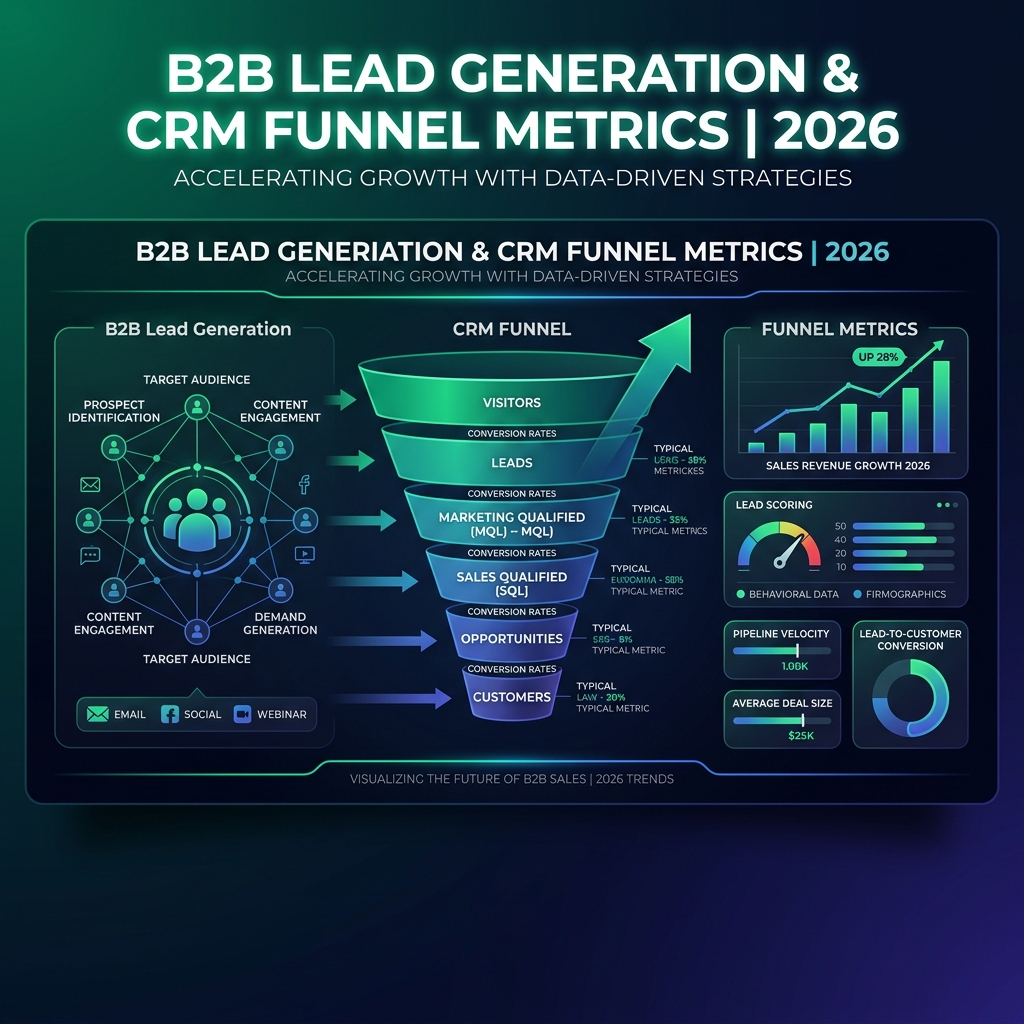
Finding prospects → Enriching data → Checking intent → Qualifying leads → Outreach → Follow-up → Conversion
The important part is that lead generation should not stop at collecting names and email addresses.
The real value comes from understanding which prospects are worth your sales team's time.
Why B2B Lead Generation Is Changing in 2026
The B2B sales process is becoming more data-driven.
Sales teams now have access to AI tools, automation platforms, intent signals, CRM systems, website intelligence, and social data.
AI is also becoming a normal part of sales workflows. Salesforce's 2026 State of Sales research reports that 87% of sales organizations currently use some form of AI, while 54% say they have used AI agents.
But technology alone does not guarantee better leads.
Bad data + good AI = bad results.
The same Salesforce research found that 51% of sales leaders with AI say disconnected systems are slowing down their AI initiatives, while 74% of sales professionals are focusing on data cleansing.
This is why modern B2B lead generation is moving toward a combination of:
- Better data
- AI-assisted prospecting
- Buyer intent
- Personalization
- Automation
- Human decision-making
8 Modern B2B Lead Generation Techniques for 2026
1. Use AI for Smarter Prospecting
AI is one of the biggest changes in modern B2B sales.
Instead of manually researching hundreds of companies, AI-powered systems can help sales teams:
- Find potential companies
- Identify decision-makers
- Enrich company information
- Analyze websites
- Identify technologies being used
- Score prospects
- Prioritize leads
- Assist with personalized outreach
The goal is not to replace the sales team.
The goal is to reduce repetitive research and give salespeople better information before they contact a prospect.
For example, instead of giving a salesperson a list of 1,000 companies, an AI-assisted system can help narrow that list to companies that match the ideal customer profile.
This makes the sales team's time more valuable.
Salesforce's 2026 research also shows that AI is being used across prospecting, lead scoring, forecasting, and email creation.
2. Focus on Your Ideal Customer Profile
One of the simplest ways to improve B2B lead generation is to define your Ideal Customer Profile (ICP).
Your ICP describes the type of business that is most likely to benefit from your product.
For example:
Company size: 50–500 employees
Industry: SaaS and technology
Location: India, UK and US
Decision-maker: Founder, HR Head or Operations Manager
Problem: Manual HR processes
Budget: Mid-market software budget
Once your ICP is clear, your prospecting becomes much more focused.
Instead of asking:
"How many leads can we find?"
Ask:
"How many relevant companies can we find?"
That small change can make a big difference to the quality of your sales pipeline.
3. Use Intent Signals
Not every company that matches your ICP is ready to buy.
This is where buyer intent becomes useful.
Intent signals can include things such as:
- Visiting product pages
- Searching for a solution
- Downloading resources
- Repeated website visits
- Looking at pricing pages
- Hiring for a relevant role
- Ad engagement
- Technology changes
- Interactions with your content
For example, if a company repeatedly visits your pricing page and then checks your product documentation, that may be more useful than simply knowing that the company fits your industry criteria.
Intent does not guarantee that someone will buy.
But it can help your team decide who deserves attention first.
4. Personalize Your Outreach
Personalization is another important part of modern B2B lead generation.
But personalization does not mean adding someone's first name to an email.
Real personalization means understanding the prospect's business.
For example, instead of:
"Hi John, we provide great lead generation solutions for businesses."
You could say:
"Hi John, I noticed your company is expanding its sales team. If your team is spending a lot of time manually researching prospects, an automated prospecting workflow could help reduce that workload."
The second message has context.
AI can help create personalized drafts, but humans should still review them before sending.
This is especially important because automated personalization can easily become repetitive when the underlying data is weak.
5. Combine Multiple Lead Sources
Modern B2B lead generation should not depend on one channel.
A stronger strategy can combine:
- Website traffic
- Organic search
- Content marketing
- Paid advertising
- Email outreach
- Referral programs
- Industry communities
- Events and webinars
- Prospecting platforms
Each channel plays a different role.
For example:
SEO can bring people who are already searching for a solution.
LinkedIn can help identify professionals and companies.
Outbound prospecting can help reach specific accounts.
Content marketing can build trust before the sales conversation.
The best approach is usually not choosing one channel.
It is connecting the channels together.
6. Improve Lead Scoring
Once you have leads, you need a way to prioritize them.
This is where lead scoring becomes useful.
A basic scoring model could look like this:

These numbers are only examples.
Every business should create its scoring model based on its own sales process.
The purpose is simple:
High-fit + high-interest leads should receive attention first.
AI can make this process more dynamic by analyzing multiple signals instead of relying only on fixed rules.
7. Automate Repetitive Sales Tasks
Salespeople spend a lot of time on repetitive work.
For example:
- Searching for companies
- Copying information into spreadsheets
- Checking websites
- Updating CRM records
- Writing basic follow-ups
- Sorting leads
- Removing duplicates
Automation can reduce this workload.
The idea is not to automate every customer interaction.
Instead, automate the repetitive parts so your sales team can spend more time on:
- Conversations
- Product demonstrations
- Negotiations
- Relationship building
- Closing deals
This is becoming increasingly important as sales teams adopt AI agents. Salesforce reports that 54% of sales organizations have used AI agents and 88% expect to use them within two years.
8. Keep Your Lead Data Clean
This is one of the most overlooked parts of B2B lead generation.
A lead database can become messy very quickly.
You may have:
- Duplicate companies
- Wrong email addresses
- Old job titles
- Incorrect phone numbers
- Outdated company information
- Missing industry information
- Incomplete profiles
Poor data affects everything that comes after it.
Your sales team may contact the wrong person.
Your personalization may be incorrect.
Your lead scoring may become unreliable.
Your reports may also become inaccurate.
That is why data quality should be treated as part of lead generation, not as an afterthought.
Salesforce's 2026 research found that high-performing sales teams are more likely to prioritize data hygiene.
How AI Is Changing B2B Prospecting
AI is changing how sales teams approach prospecting.
Traditional prospecting often looks like this:
Search → Copy data → Create list → Research manually → Write email → Contact
A modern workflow can look more like:
Define ICP → Discover companies → Analyze prospects → Score leads → Personalize outreach → Review → Contact
The biggest advantage is not simply speed.
It is better prioritization.
For example, VoidOnyx's lead generation platform is designed around finding and understanding potential customers instead of simply producing a large contact list.
The platform includes capabilities such as website intelligence, contact enrichment, CRM lead pipeline management, and AI-powered prospecting.
Explore VoidOnyx Lead Generator
Why Data Quality Matters More Than Lead Volume
Getting 10,000 leads may sound impressive.
But what if only 100 are relevant?
A smaller list of well-qualified prospects can be much more useful than a huge list of random contacts.
Think about it this way:
1,000 irrelevant leads = more work
100 relevant leads = better opportunity
This is why businesses should track quality metrics alongside lead volume.
Useful metrics include:
- Qualified leads
- Lead-to-meeting rate
- Meeting-to-opportunity rate
- Opportunity-to-customer rate
- Cost per qualified lead
- Conversion rate
- Sales cycle length
These numbers tell you whether your lead generation system is actually contributing to revenue.
Building a Multi-Channel B2B Lead Generation Strategy
A simple modern workflow can look like this:
Step 1: Define your ICP
Decide who your ideal customer is.
Step 2: Discover companies
Find businesses that match your target market.
Step 3: Enrich the data
Collect useful information about the company and relevant decision-makers.
Step 4: Analyze intent
Look for signals that suggest potential interest.
Step 5: Score the leads
Prioritize prospects based on fit and intent.
Step 6: Personalize the message
Create outreach based on the prospect's actual business situation.
Step 7: Follow up
Use a structured follow-up process rather than sending one message and stopping.
Step 8: Track the result
Measure which leads, channels and campaigns actually create opportunities.
How VoidOnyx Helps Businesses Generate Leads
At VoidOnyx, our goal is to make the prospecting process easier for businesses.
The VoidOnyx Lead Generator brings multiple prospecting functions into one platform.
Businesses can use it to discover potential customers and analyze information such as:
- Business details
- Industry
- Location
- Technology stack
- Intent signals
- SEO information
- Prospect information
The platform also provides an AI-powered prospecting workflow so businesses can spend less time manually researching every company.
See the VoidOnyx Lead Generator
Where VoidPanel Fits In
Lead generation is only one part of running a digital business.
Businesses also need infrastructure to manage their websites, servers, databases, security and other services.
This is where VoidPanel fits into the wider VoidOnyx ecosystem.
VoidPanel provides a central interface for managing hosting infrastructure and related services.
Learn more about VoidPanel
The idea is simple:
Lead generation helps you find opportunities.
Your business infrastructure helps you run and manage those opportunities.
A Simple B2B Lead Generation Workflow for 2026
Instead of using a complicated flowchart, think of the process as five simple stages:
1. Discover
Find companies that match your target customer profile.
2. Understand
Analyze their business, technology, industry and potential needs.
3. Prioritize
Use scoring and intent signals to identify the most relevant prospects.
4. Engage
Reach out with a useful and personalized message.
5. Convert
Move qualified prospects into your CRM and sales pipeline.
Discover → Understand → Prioritize → Engage → Convert
This approach keeps lead generation focused on business outcomes instead of just collecting contacts.
Common B2B Lead Generation Mistakes
Even with good tools, businesses can make simple mistakes.
Buying huge contact lists
A large list does not automatically mean a strong pipeline.
Focus on relevance and data quality.
Sending the same message to everyone
Different industries and decision-makers have different problems.
Personalize your outreach.
Ignoring existing website visitors
Someone already researching your product may be more valuable than a completely cold prospect.
Using AI without checking the data
AI can process information quickly, but incorrect input can produce incorrect results.
Always review important prospect information.
Measuring only the number of leads
Lead volume is not the final goal.
Track qualified leads, meetings, opportunities and conversions.
B2B Lead Generation Checklist for 2026
Before launching your next campaign, check the following:
- Ideal Customer Profile is clearly defined
- Target industries are selected
- Target company size is defined
- Decision-makers are identified
- Lead data is verified
- Duplicate leads are removed
- Intent signals are considered
- Lead scoring is configured
- Outreach messages are personalized
- Multiple channels are being used
- Follow-ups are planned
- CRM data is updated
- Conversion metrics are tracked
- AI-generated information is reviewed by a human
Frequently Asked Questions
What is B2B lead generation?
B2B lead generation is the process of finding and qualifying businesses or decision-makers who may be interested in your products or services.
What is the best B2B lead generation technique in 2026?
There is no single technique that works for every business. A strong strategy usually combines accurate targeting, AI-assisted prospecting, intent signals, personalization, multiple channels and proper lead scoring.
How can AI help with B2B lead generation?
AI can help with prospect research, company discovery, data enrichment, lead scoring, personalization and repetitive sales tasks.
Is cold outreach still useful in 2026?
Yes, but the quality of targeting matters. Random mass outreach is less useful than targeted outreach based on a clear ICP and relevant business context.
How many leads should a business generate?
There is no universal number. Businesses should focus on generating enough qualified leads to support their sales targets rather than chasing a specific lead count.
What is an ideal customer profile?
An Ideal Customer Profile describes the type of company that is most likely to benefit from your product or service. It can include industry, company size, location, technology, budget and business needs.
Conclusion
B2B lead generation in 2026 is moving away from simply collecting as many contacts as possible.
The better approach is to find the right companies, understand their needs, identify useful signals, and reach out with relevant information.
AI can make this process faster, but good data and human judgment still matter.
For businesses, the winning combination is simple:
Better data + smarter prospecting + useful personalization + automation + human judgment.
At VoidOnyx, we are building tools that help businesses manage this process more efficiently.
If your team is spending too much time searching for prospects and not enough time talking to potential customers, it may be time to modernize your lead generation workflow.